



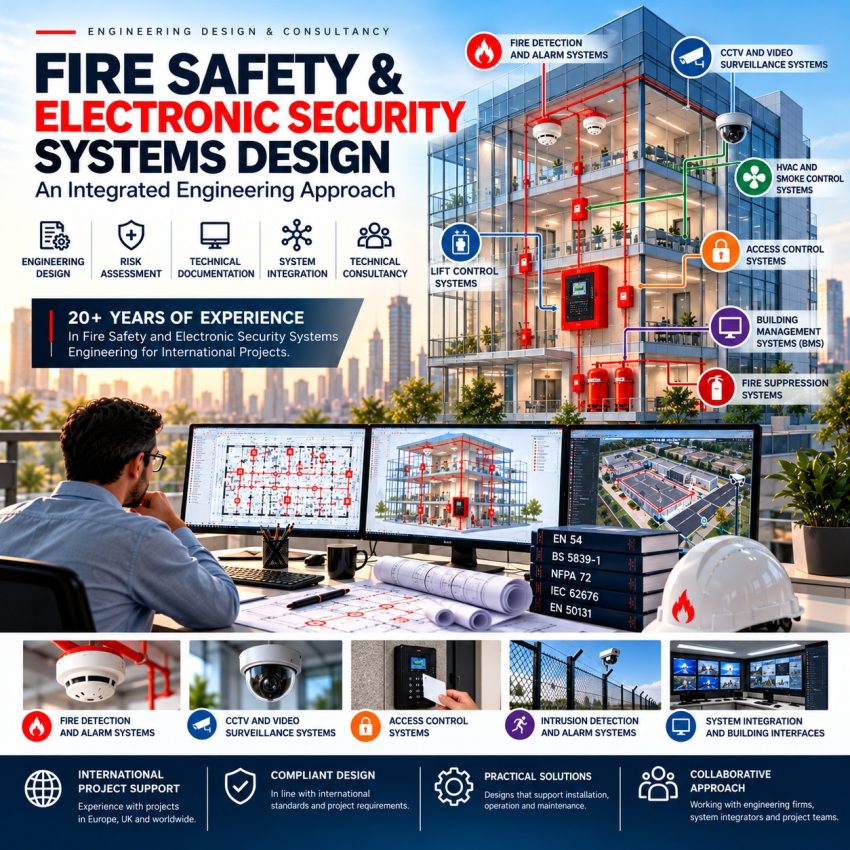
Fire Safety & Electronic Security Systems Design: An Integrated Engineering Approach
20+ Years of Engineering Experience | Risk Assessment | Engineering Design | System Integration | Technical Consultancy | International Project Support
What Is Fire Safety and Electronic Security Systems Design?
Fire safety and electronic security systems design is the engineering process of evaluating risks associated with buildings, industrial facilities and critical infrastructure, and developing technical solutions that support life safety, asset protection and business continuity.
This process may include fire detection and alarm systems, closed-circuit television (CCTV), electronic access control, intrusion detection systems and coordination with other building services.

Effective security system design involves more than selecting appropriate equipment. It requires an integrated approach to risk assessment, system architecture, technical documentation, compliance with applicable standards and multidisciplinary engineering coordination.
The objective of effective engineering design is not simply to install independent devices, but to develop reliable, maintainable and coordinated systems that address identified risks and operational requirements.
Since 2005, I have been professionally involved in engineering design, risk assessment, technical documentation, system integration, project management and technical consultancy within the fire safety and electronic security systems industry.
Drawing on more than 20 years of professional experience, I consider security systems design not merely an equipment selection process, but an engineering discipline that influences the overall success of a project.
This article explores the fundamental principles of fire safety and electronic security systems design, technical challenges encountered by engineering companies, typical engineering deliverables and opportunities for international technical collaboration.

1. Why Should Fire Safety and Electronic Security Systems Be Considered Together?
Modern buildings incorporate numerous technical systems designed to serve different operational and safety objectives.
Fire detection systems are intended to detect fire-related hazards and initiate the necessary notification or control functions.
Electronic security systems, on the other hand, support functions such as preventing unauthorised access, monitoring designated areas and managing security incidents.
Although these systems have different primary objectives, certain operational and emergency scenarios may require coordinated operation.
For example, access control systems may restrict entry to designated areas during normal building operation. However, door functions that could affect safe evacuation during a fire or another emergency must be designed in accordance with the approved fire safety strategy.
Similarly, CCTV systems can provide visual information to support security operations. Nevertheless, video surveillance systems do not replace required fire detection and alarm functions.
Two fundamental engineering principles are therefore essential:
- Each system must be designed according to its own purpose, performance requirements and applicable technical standards.
- Interactions between systems must be coordinated while maintaining the necessary safety priorities and regulatory requirements.
Integrated security engineering does not simply mean connecting every system to a single platform. It means correctly defining and safely managing the relationships between different systems.
The Importance of Integration for Engineering Consultancies
In multidisciplinary projects, fire safety, electronic security, electrical, mechanical and architectural teams may have different technical responsibilities.
Insufficient coordination between these disciplines can result in equipment location conflicts, unclear control scenarios, incomplete system interfaces and repeated design revisions.
Technical coordination during the early design stages can help reduce these risks and support the development of more consistent engineering decisions.
2. Fire Safety Engineering and Fire Alarm System Design
Fire safety engineering is an important discipline concerned with evaluating fire-related risks and developing appropriate protection strategies for buildings and facilities.
Fire detection and alarm system design is one of the technical components supporting the overall fire safety strategy.
A well-developed fire alarm engineering project should address:
- Building occupancy and fire hazards
- Detection coverage and protected areas
- Selection of appropriate detection technologies
- Fire alarm control panels and system architecture
- Detection zones and loop arrangements
- Alarm and evacuation strategies
- Fire scenarios and cause-and-effect relationships
- Control functions and system interfaces
- Technical drawings and engineering documentation
Risk-Based Fire Alarm System Design
A hospital, hotel, data centre or industrial facility does not necessarily have the same fire hazards or operational requirements.
Consequently, detector selection and system layout should not be based solely on the physical dimensions of architectural drawings.
Environmental factors such as airflow, dust, humidity, temperature, operational activities and expected fire characteristics may influence the detection strategy.
The primary objective of engineering design is not to maximise the number of devices, but to achieve detection performance appropriate to the identified risks and technical requirements.
This approach can support reliable system performance while helping reduce unwanted alarms and maintenance difficulties during building operation.
Technical Engineering Support for Fire Alarm Projects
Engineering documentation for fire detection and alarm projects may include system layout drawings, block diagrams, device schedules, technical specifications, interface documentation and cause-and-effect matrices.
Depending on the project scope, these activities can support design development, technical review and multidisciplinary engineering coordination.
 3. Electronic Security Systems Design and Risk Assessment
 3. Electronic Security Systems Design and Risk Assessment
Electronic security systems form the technological components of a physical security strategy.
Their primary purpose is to support the management of identified security risks, detection of security incidents, provision of relevant information and implementation of appropriate measures against unauthorised activities.
However, the effectiveness of an electronic security system cannot be measured simply by the number of cameras, card readers or alarm detectors installed.
An effective solution should be developed according to the facility’s security objectives, risk profile and operational requirements.
3.1. CCTV and Video Surveillance System Design
CCTV system design is a more comprehensive engineering process than positioning cameras on architectural drawings.
An appropriately designed video surveillance system should consider:
- Security objectives and surveillance scenarios
- Camera locations and fields of view
- Image quality and required level of detail
- Lighting and environmental conditions
- Network infrastructure and transmission capacity
- Recording and data storage requirements
- Centralised monitoring and system management
- Access permissions, cybersecurity and data protection requirements
High camera resolution alone does not guarantee that the required image quality or operational objective will be achieved.
Camera positioning, lens selection, scene characteristics, lighting conditions and the intended surveillance purpose must be evaluated together.
For example, monitoring vehicle movements at a car park entrance may require different design considerations from providing general surveillance of a large warehouse.
For international projects, technical references such as the IEC 62676 series may be considered for video surveillance systems.
Where personal data is processed, the relevant data protection legislation must also be taken into account.
3.2. Electronic Access Control System Design
Electronic access control systems manage entry and exit permissions for buildings and designated areas.
Important considerations during system design include:
- Classification of doors and access points
- Access authorisation levels
- Card readers and authentication methods
- Door hardware and locking arrangements
- Controller and communication architecture
- Centralised management and event recording
- Emergency and evacuation requirements
- Integration with other security and building systems
Particular attention is required where fire safety and access control functions interact.
Electric locking arrangements and access control scenarios must be evaluated to ensure that the relevant fire safety and evacuation requirements are satisfied.
Avoiding conflicts between security objectives and life safety requirements is a fundamental engineering priority.
3.3. Intrusion Detection and Alarm Systems
Intrusion detection systems are intended to detect unauthorised activities within designated areas and support the relevant security response procedures.
Their design requires consideration of the characteristics of the protected areas, detection zones, device selection, environmental conditions, alarm communication and operational procedures.
The effectiveness of these systems depends not only on the selected technologies but also on appropriate risk assessment and operational organisation.
4. Integrated Security Systems and Multidisciplinary Engineering Coordination
In large-scale projects, fire safety and electronic security systems should be considered alongside other building services.
These may include Building Management Systems (BMS), mechanical ventilation, smoke control, lifts, access control and centralised security monitoring platforms.
The following questions are essential during integration design:
- Which systems require technical interfaces?
- Which events should initiate specific actions?
- How should control authority and system priorities be defined?
- What behaviour is required during communication or equipment failures?
- Who is responsible for testing and verification?
Addressing these questions during the design stage can reduce uncertainties during installation and commissioning.
Technical Example: Fire Alarm and Access Control Coordination
In a commercial building, the access control system may restrict entry to designated areas during normal operation.
However, the behaviour of doors located along emergency escape routes must comply with the building’s approved fire safety and evacuation strategy.
In such projects, the engineering teams must jointly evaluate the characteristics of the relevant locking hardware, required control interfaces and expected system behaviour.
Design decisions may be documented through a Cause and Effect Matrix and associated interface documentation.
This example demonstrates that, although fire safety and electronic security systems serve different purposes, certain functions require coordinated engineering design.
5. Engineering Design and Technical Documentation Services
 5. Engineering Design and Technical Documentation Services
For engineering consultancies, system integrators and project contractors, accurate technical documentation is an important factor influencing successful project delivery.
Incomplete or inconsistent drawings can result in different interpretations during installation, coordination difficulties and additional design revisions.
Depending on the project scope, engineering deliverables may include:
| Engineering Deliverable | Main Purpose |
|---|---|
| System Layout Drawings | Define equipment and device locations |
| System Architecture Diagrams | Illustrate system components and their relationships |
| Cable and Connection Details | Establish infrastructure requirements |
| Device and Equipment Schedules | Define technical equipment requirements |
| Technical Specifications | Establish system and equipment performance requirements |
| Cause and Effect Matrix | Define control functions associated with specified events |
| System Interface Documentation | Describe technical relationships between different systems |
| Technical Review Reports | Evaluate design consistency and coordination issues |
The Value of Well-Prepared Engineering Documentation
Clearly defined and consistent engineering documentation can:
- Improve understanding of project requirements
- Strengthen coordination between engineering disciplines
- Reduce technical uncertainty and unnecessary revisions
- Provide clearer technical requirements for procurement and installation
- Support testing, commissioning and handover procedures
- Establish a reference for future system modifications and maintenance
For this reason, engineering documentation should not be regarded merely as the production of technical drawings.
It is an engineering activity that supports multiple stages of the project lifecycle.
6. Compliance with Technical Standards in Fire Safety and Electronic Security Engineering
Fire safety and electronic security systems must be designed according to the applicable legislation and project requirements of the country where they will be installed.
Technical references that may be relevant to international engineering projects include:
| Standard | Relevant Application |
|---|---|
| EN 54 Series | Fire detection and alarm system components |
| CEN/TS 54-14 | Guidance for planning, design and implementation of fire detection and alarm systems |
| BS 5839-1 | Fire detection and alarm systems in non-domestic premises in the United Kingdom |
| NFPA 72 | Fire alarm, signalling and emergency communications systems |
| IEC 62676 Series | Video surveillance systems for security applications |
| IEC 60839-11 Series | Electronic access control systems |
| EN 50131 Series | Intrusion and hold-up alarm systems |
These standards cover different technical areas, and not all of them are necessarily applicable to every project.
The relevant requirements must be determined according to the project location, building classification, system scope and competent authorities.
Technical evaluation based on international standards does not replace locally required engineering authorisation or statutory project approval.
Engineering design, technical consultancy, site verification, compliance assessment and official approval responsibilities must be clearly defined for each project.
7. Which Projects May Require Fire Safety and Electronic Security Engineering Support?
The design requirements of fire safety and electronic security systems vary according to the intended use and operational characteristics of each facility.
Commercial Buildings and Office Developments
Coordinated planning of fire detection, access control, video surveillance and building systems integration is important in commercial building projects.
Hospitals and Healthcare Facilities
Patient safety, different occupant groups, operational continuity and controlled access areas may require specific engineering considerations.
Industrial Facilities and Logistics Centres
Environmental conditions, operational processes, equipment characteristics and large-area security requirements can influence engineering design decisions.
Hotels and Hospitality Developments
Guest safety, evacuation arrangements, communal areas and access control systems must be appropriately coordinated.
Data Centres and Critical Infrastructure
Business continuity, controlled access, fire detection strategy, system reliability and technical infrastructure coordination are particularly important.
The appropriate engineering solution for each facility should be developed according to its identified risks and technical requirements.
8. Remote Engineering Design and Project Support for International Companies
International engineering companies may require additional technical capacity during periods of increased workload or for specific engineering documentation activities.
Project-based technical collaboration can be considered to address such requirements.
Where appropriate project documentation is available and the scope of work is clearly defined, certain design, drafting and technical review activities can be performed remotely.
Potential Areas of Project-Based Collaboration
Technical collaboration opportunities in fire safety and electronic security engineering may include:
Engineering Design: System layouts, architectural and technical infrastructure evaluations, system architecture and design development activities.
Technical Drawings and Documentation: CAD-based drawings, system diagrams, equipment schedules, interface documentation and technical specifications.
Risk Assessment: Risk-based evaluation of project requirements relating to fire safety and electronic security systems.
Design Review: Assessment of existing engineering documents, system arrangements and multidisciplinary design relationships.
System Integration and Coordination: Evaluation of technical interfaces between fire detection, CCTV, access control and associated building systems.
These activities may provide opportunities for collaboration with international engineering consultancies, MEP design offices, security system integrators and project contractors.
9. How Does an Engineering Project Collaboration Process Work?
Successful project-based technical collaboration requires the scope of work and delivery expectations to be established at the beginning of the assignment.
Step 1 — Project Requirements Assessment
The client provides relevant information about the building type, project location, architectural drawings, existing system documentation, applicable standards and required engineering services.
Step 2 — Definition of Scope of Work
Required drawings, technical documents, review activities, deliverable formats, coordination responsibilities and target schedule are defined.
Step 3 — Engineering Design and Documentation
Technical activities are carried out according to the agreed scope.
Where necessary, missing project information and design decisions requiring clarification are communicated to the client.
Step 4 — Technical Review and Revisions
Prepared engineering documentation is submitted to the relevant project team for review.
Comments and required modifications are addressed through the agreed revision process.
Step 5 — Final Documentation Delivery
Final engineering deliverables are issued in the agreed format and revision status.
Any required statutory approvals and legally regulated engineering responsibilities remain with the appropriately authorised professionals.
Transparent communication, clearly defined deliverables and systematic document management are essential foundations of international engineering collaboration.
10. My Engineering and Technical Consultancy Approach: Over 20 Years of Professional Experience
Since 2005, I have undertaken various technical and managerial responsibilities within the fire safety and electronic security systems industry.
My professional activities have included requirements analysis, risk assessment, engineering design, site surveys, technical specification development, project management, installation coordination, system integration and project handover processes.
This experience has shaped my engineering approach and reinforced the importance of considering a project as more than a collection of technical drawings.
Three fundamental principles are central to my approach:
Technical Accuracy: Developing engineering decisions based on identified risks, relevant standards and project-specific technical requirements.
Coordination: Evaluating the relationships between fire safety, electronic security, electrical, mechanical and architectural disciplines.
Practical Implementation: Considering engineering solutions in relation to installation, operation, maintenance and the overall system lifecycle.
My primary objective in engineering services is to understand the client’s project requirements and carry out systematic, transparent and coordinated technical work within an agreed scope.
Frequently Asked Questions
What is the difference between fire safety engineering and electronic security systems design?
Fire safety systems focus on detecting fire-related hazards and supporting the necessary life safety functions.
Electronic security systems support objectives such as controlling unauthorised access, video surveillance and detecting security incidents.
In certain projects, these systems require coordinated operation.
Can fire alarm, CCTV and access control systems be designed within the same project?
Yes. These systems may be developed as different engineering disciplines within the same building project.
Their technical requirements, system architectures and necessary interfaces can be evaluated in a coordinated manner.
However, the individual technical and regulatory requirements of each system must be maintained.
Why is risk assessment important in CCTV and access control design?
Risk assessment helps identify the assets requiring protection, potential threats and expected security functions.
This evaluation supports the selection of equipment and development of system architecture based on actual security requirements.
Can international engineering companies receive remote design and documentation support?
Yes. With appropriate project information, clearly defined deliverables and effective coordination procedures, selected engineering drawings, technical documentation and design review activities can be performed remotely.
Local approval and professional authorisation requirements must be evaluated separately.
Can existing fire safety or electronic security system designs be technically reviewed?
Yes. Existing engineering documentation can be reviewed to evaluate system architecture, equipment layouts, device selection, interfaces and documentation consistency.
The review scope must be defined according to the available information and project requirements.
How can I request a quotation for engineering and technical consultancy services?
For an initial evaluation, it is useful to provide the project type, country, available technical documentation, required services, applicable standards and target delivery schedule.
This information helps define the potential scope of work and appropriate technical collaboration model.
Conclusion: Reliable Safety and Security Systems Begin with Effective Engineering
Fire safety and electronic security systems design involves much more than equipment selection or technical drawing preparation.
It is a comprehensive engineering process requiring an understanding of risks, development of appropriate technical solutions, evaluation of applicable standards and coordination between different building systems.
An effective design approach supports system reliability, operational requirements and the efficient management of project implementation activities.
Drawing on more than 20 years of professional experience, I am open to international engineering collaboration and project-based technical assignments in fire safety, electronic security systems and engineering design.
Looking for Fire Safety or Electronic Security Engineering Support?
I welcome opportunities for technical collaboration with international engineering consultancies, MEP design offices, security system integrators and project contractors.
If your project requires engineering support in any of the following areas, please feel free to contact me:
- Fire safety and fire detection system design
- CCTV and electronic security systems engineering
- Access control and security system architecture
- Technical drawings and engineering documentation
- Risk assessment and system design review
- System integration and multidisciplinary coordination
- Remote engineering and project-based technical support
Let’s Discuss Your Project
For an initial discussion, you can share your project location, building type, required technical services and target delivery schedule.
By reviewing your project documentation and requirements, we can discuss an appropriate scope of work and potential collaboration model.
Contact Me — Request Engineering Support
Fire Safety | Electronic Security Systems | Engineering Design | Technical Consultancy | International Project Collaboration
Technical References and Resources
- CEN/TS 54-14:2018 — Fire Detection and Fire Alarm Systems: Guidelines for Planning, Design, Installation, Commissioning, Use and Maintenance
- BS 5839-1:2025 — Fire Detection and Alarm Systems in Non-Domestic Premises
- NFPA 72 — National Fire Alarm and Signaling Code
- IEC 62676-4:2025 — Video Surveillance Systems for Use in Security Applications: Application Guidelines
- IEC 60839-11-1 — Electronic Access Control Systems
- European Data Protection Board — Guidelines on Processing Personal Data Through Video Devices
Technical Notice: This article is intended to provide general engineering information and describe potential areas of technical collaboration. Project-specific engineering design, regulatory compliance, certification, professional authorisation and statutory approval responsibilities must be evaluated according to the applicable requirements of the relevant jurisdiction.


